
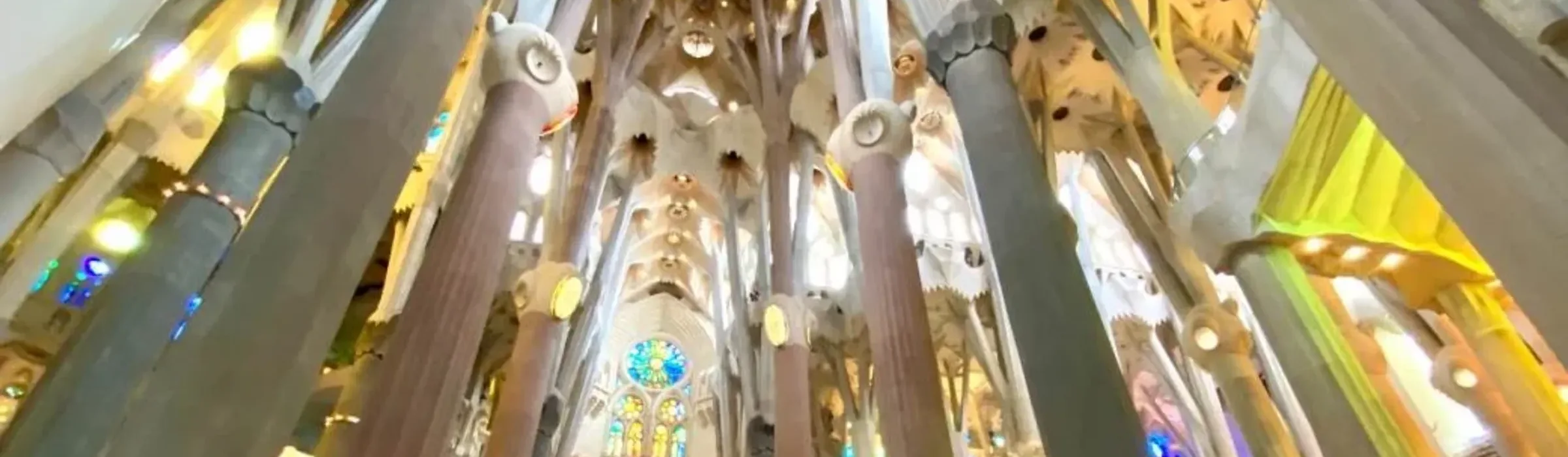
Barcelona's most famous buildings are also some of the best places to escape the midday heat. Step inside Sagrada Família's stained glass, the wave-walled rooms of Casa Batlló and La Pedrera, and the calmer halls of Palau Güell, Casa Vicens, and the Hospital de Sant Pau. Every interior is air-conditioned and full of the details kids love, from dragon scales to mushroom columns to secret rooftops.
On the map
6 spots on the map
What’s in this collection
Gaudí's still-unfinished basilica, started in 1882 and topping out at over 170 metres. Inside, branching stone columns rise like a forest while morning and afternoon sun pours through walls of red, blue, and green stained glass. The audio guide has a kids' track, the carved Nativity and Passion façades work like a picture book, and a lift carries visitors up one of the towers.
Antoni Gaudí remodeled this Passeig de Gràcia townhouse between 1904 and 1906, and almost nothing inside is straight. The route climbs from the blue-tiled central light well to a noble floor of wavy stained-glass windows and a mushroom fireplace, then up to the rooftop terrace, whose scaled, dragon-back ridge and mosaic chimneys are the high point. A tablet guide animates each room.
Gaudí's last apartment building has a self-supporting stone facade with no straight walls and twisting wrought-iron balconies. The visit climbs through two plant-filled inner courtyards to the Whale Attic, a hall of parabolic brick arches holding an exhibition on Gaudí's work, then out onto the rooftop terrace where sculpted chimneys and stair towers look like stone warriors. A restored 1900s flat shows how residents actually lived.
An early Antoni Gaudí mansion, built 1886 to 1888 for the Güell family. The tour runs from a brick-columned basement stable, where carriage horses were kept, up to a central hall topped by a dome pierced with small holes that let light fall like stars. The flat roof is set with cone chimneys covered in broken-tile mosaic.
Gaudí's first major building, finished in 1885 and now a house-museum across three floors and a small garden. Inside are the original tiled smoking room, dining room, and decorated ceilings; outside, green-and-white checkerboard tiles and marigold motifs cover the facade. Kids can climb to the rooftop terrace with its chimneys and walkways.
Designed by Lluis Domenech i Montaner and built between 1902 and 1930, this UNESCO-listed site is the world's largest Art Nouveau complex: 12 restored pavilions covered in colored tile, sculpture, and stained glass, set among open gardens and linked by long underground tunnels kids can walk through. Self-guided routes pass mosaic murals, domed ceilings, and a scale model of the campus.
