
Green space across the city, from the lake and playgrounds of Ciutadella to giant slides at Diagonal Mar, hilltop lookouts, and design-led parks built for running and scooting. Most are free and open daily, so you can pick one near home or near wherever the day takes you.
On the map
12 spots on the map
What’s in this collection
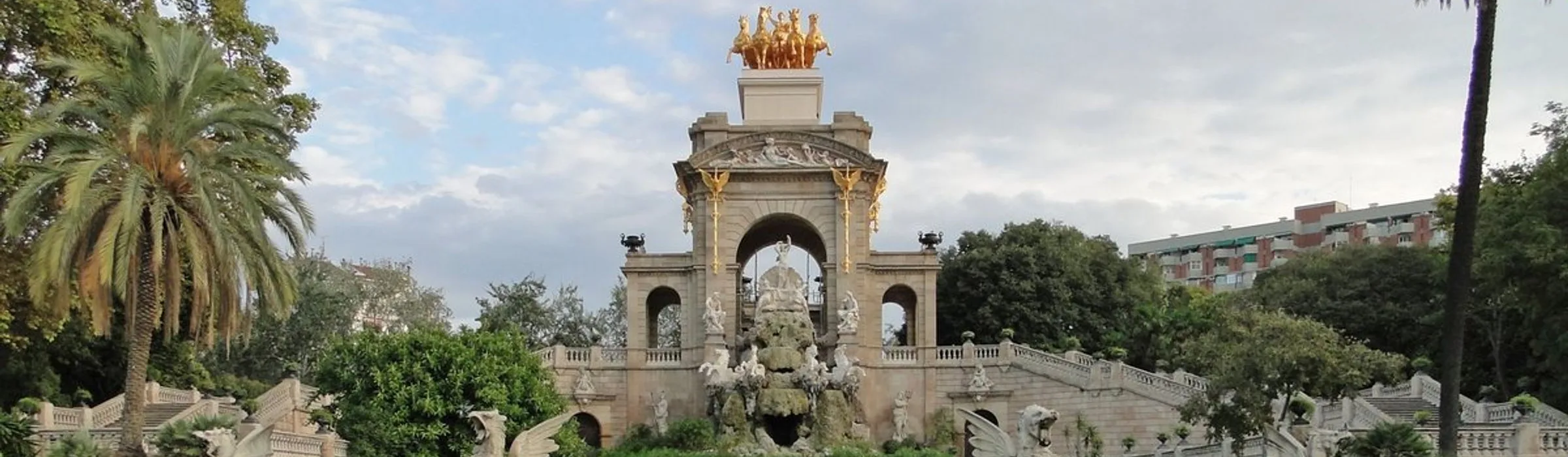
Parc de la Ciutadella covers 17 hectares of flat, shaded paths around a rowing-boat lake. Kids can climb the life-size stone mammoth, explore the monumental Cascada fountain (a young Gaudí helped design it), and visit the Castell dels Tres Dragons. Several playgrounds are dotted through the grounds, and Barcelona Zoo occupies the southern half. Open daily, 7am to dusk.
A large park beside Barcelona-Sants station, built on a former textile mill, with an artificial lake ringed by nine white lighthouse towers and terraced steps. The headline for kids is El Drac, a 32-meter steel dragon by Andrés Nagel that doubles as a slide: children climb onto its back and shoot out of its mouth. A separate fenced playground serves younger ones, with open plazas for scooters.
One of the largest open green spaces near Plaça d'Espanya, on the site of the old city abattoir behind the Las Arenas center. Six playgrounds spread across the park, the biggest fully accessible, set among shady pine groves, alongside ping-pong and pétanque. Towering over the main square is Miró's 22-meter Dona i Ocell sculpture, and the on-site library has a big children's section.
A relaxed lawned park behind the Nord bus station, built around two giant ceramic-tiled earthworks by sculptor Beverly Pepper. The blue Cel Caigut rises from the grass like a wave, and kids treat the sloping mounds as something to climb and roll down. There is a playground, ping-pong tables and a basketball hoop, with shade under the spiral of lime trees.
Built on old railway workshops, this park keeps the factory bones: a line of stone arches ends in a waterfall over a small lake, brick pillars stand like ruins among the trees, and a high metal walkway runs above a sunken sports court. There are three playgrounds for different ages, grassy hills to climb and ping-pong tables, a short walk from Clot station.
A hillside park that climbs in three zones: a flat lower section with playgrounds, formal historic gardens in the middle, and pine-and-holm-oak woodland at the top. Steep paths lead up to the Mitja Lluna lookout, whose panorama takes in the Sagrada Família, Torre Glòries and the sea, a free view many locals rate above nearby Park Güell. Wear sturdy shoes for the climb.
A wooded hilltop park in a quiet residential corner of the city, with gently ramped paths through shady Mediterranean woodland that stay walkable even with a stroller. Trails connect open squares with room to run, and stone steps climb to a mirador with a 360-degree panorama over Tibidabo, the Sagrada Família and the sea. A wood-themed playground sits among the gardens.
A 14-hectare modern park near the Fòrum, threaded by a snaking steel structure that carries water to the gardens, with a central lake and trencadís-mosaic planters. Its signature feature is a set of giant slides built into a grassy hill, wide enough for a parent and child to ride together, plus two playgrounds, football, basketball and a skating area.
A 5.5-hectare park by architect Jean Nouvel, built around the theme of shade, with roughly 1,000 Mediterranean trees, palms and bougainvillea-draped perimeter walls. For families the appeal is space and variety: several play areas dotted through the park, plus pétanque courts, table-tennis, basketball hoops and wide paths that are great for scooters and bikes. On-site facilities are limited, so bring water.
A huge paved seafront esplanade built for the 2004 Universal Forum, anchored by a tilted photovoltaic pergola the size of a football pitch raised on stilts. Kids come for the Bosc Urbà rope-and-zipline adventure forest, the enclosed saltwater Zona de Banys with step access for confident swimmers, and summer kayak and paddleboard sessions at the marina.
The oldest surviving garden in the city, laid out from 1791 around a clipped-cypress hedge maze with a statue of Eros at its heart, ringed by fountains, terraces, temples and a romantic waterfall garden. It is calm and green, a half-day out for kids who like exploring. The maze itself is closed for restoration until early 2027, though the rest of the gardens stay open.
Grand public gardens hidden behind a wall of bougainvillea on the Diagonal, laid out around an early-20th-century royal palace with lawns, fountains and an oval pool. Wide gravel paths and shady pines give little ones room to run, and there is a playground inside. The hidden highlight is the Font d'Hèrcules, a dragon-spout fountain designed by a young Gaudí.
